
AOP Releases Endangered Frog Species Back into Wild
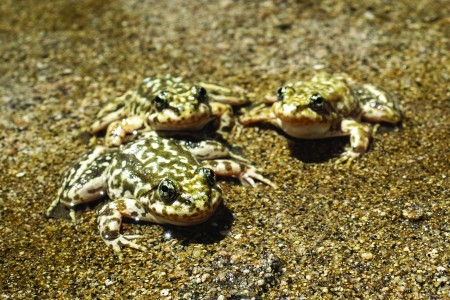
Major conservation efforts have been made over at the Aquarium of the Pacific (AOP) this summer, as aquarium biologists have been working to raise and release an endangered species of frog back into its natural habitat.
Named after the bright yellow or pale orange coloring on their underside and hind legs, a contrast with the dark moss-like splotches and markings on its upper bodies, the Mountain Yellow-Legged Frog is native to high-altitude mountain ranges such as the Sierra Nevada and Southern California Mountain Ranges.
Approximately 653 Mountain Yellow-Legged Frogs were released back into the wild during the AOP’s latest reintroduction effort, conducted in partnership with the Los Angeles Zoo and the U.S. Geological Survey (USGS). This release brings the total number of Mountain Yellow-Legged Frogs that the AOP has helped raise and return to the wild to 1,032.
According to AOP Conservation Initiatives Manager Erin Lundy, the AOP first began its conservation efforts for the Mountain Yellow-Legged Frog immediately following the 2020 Bobcat Fire, which had impacted 95% of the species’ remaining useable habitat.
“In reaction to the fire burning their habitat, we were asked if we were willing to join as a partner for their conservation,” said Lundy. “We signed on under USGS’s permit to house and rear these animals – so in 2020 we received funding to construct a conservation area for them, and in 2021 we received our first batch of tadpoles.”
Currently, the AOP has four high-flow aquarium-like systems to house the Mountain Yellow-Frogs that come into their care. As the species metamorphosizes from tadpoles to froglets finally into frogs, AOP staff modify the facilities to match the species’ natural environment, including land space and temperature.
“They have a heat lamp that provides heat and UV,” said Lundy. “They really love their heat and UV, so they’ll sit in a little frog pile to warm up. We also feed them heavily to encourage them to grow up. These animals can grow a little faster depending on food availability and temperature.”
Lundy continued: “They’re currently housed in warm summer temperatures and we’re starting to decrease that temperature. During the winter, we will chill their temperatures to about fifty degrees to mimic natural changes to their environment out in the wild.”
When the frogs are ready to be released back into the wild, Lundy explained that the AOP works with partnered organizations such as the USGS, whose biologists help determine suitable release sites for the species’ reintroduction.
“There is a lot of science that goes into choosing which sites look good, and additionally we’ll try to match the genetics of what tadpoles we have,” said Lundy. “For example, if we have tadpoles that were from a San Gabriel lineage, then they will be released back into the San Gabriel Mountain Range to match the genetics of what evolved on that landscape.”
According to the U.S. Fish and Wildlife Service (USFWS), the Mountain Yellow-Legged Frog consists of both a Northern-Distinct and Southern-Distinct population; both of which are classified as critically endangered.
The species’ endangerment is linked to various threats, such as consumption from other wildlife and non-native trout, as well as destruction of habitat. But possibly the biggest threat to the species’ survival, according to Lundy, is the presence of chytrid fungus: a dangerous aquatic fungus that infects the skin of amphibians and causes the skin of frogs to abnormally thicken, making it difficult for them to absorb water and breath through their skin.
“Chytrid is a pretty big threat to these animals and unfortunately we are not certain as to where it originated from,” said Lundy. “There’s been some research, but now it’s become a worldwide fungal pathogen that is wiping out most species of amphibians.”
Lundy continued: “There are some species of frogs that are starting to develop what seems to be a resistance to chytrid fungus, but unfortunately Mountain Yellow-Legged Frogs are not one of them. We hope that someday they might be.”
According to Lundy, Amphibians are the most threatened taxon of vertebrates in the world, with roughly 40% of amphibians such as frogs being threatened for extinction. Lundy says that it is important for people to understand the threats to amphibians and work hard to help mitigate those threats, so that they may continue to exist in our landscape.
“I think everyone has a memory of being a child and playing with tadpoles or catching frogs, so I think robbing people of that experience in the future feels like such a shame,” said Lundy. “And the only way can ensure that kids continue to have the experience of catching frogs in the pond or in their backyard is by doing more to preserve this taxon.”
Category:
- Log in to post comments
Featured Video

Beachcomber
Copyright 2026 Beeler & Associates.
All rights reserved. Contents may not be reproduced or transmitted – by any means – without publisher's written permission.

