
Controversy Over $790,000 Library Fence Amid Service Reductions and Staff Layoffs
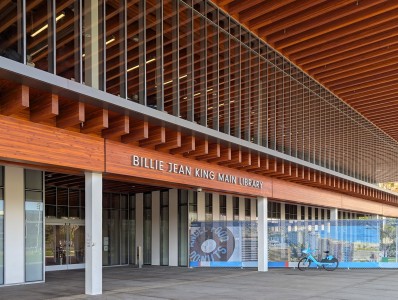
A newly installed iron fence around the Billie Jean King Main Library in Long Beach has reduced encampments and cleaning costs, according to city officials. However, it has sparked a debate over public priorities, coinciding with the city's plans to cut library hours, lay off staff, and reduce emergency services amid a $58 million budget deficit.
Completed in May 2026 for $790,000, the perimeter fence acts to isolate the rising number of unsheltered individuals. The 6- to 8-foot barrier encloses the library's southern terrace. While city officials commend it for improving safety, a municipal advisory panel has criticized it as a waste of funds that fails to address the root causes of homelessness.
The city had allocated nearly $800,000 for a physical security barrier while proposing layoffs for 11 library workers and reduced hours at five branches to save about $1.4 million. City financial records show that this stems from municipal accounting rules that separate one-time capital improvement funds from ongoing operating funds for city services.
Why is There a Fence?
The Billie Jean King Main Library, completed in September 2019 for $48 million, is integrated with Lincoln Park. Designed with expansive glass facades, it was intended as an open, accessible community space. However, its design, with wide terraces and overhangs, has attracted many unhoused individuals seeking shelter.
The new library facility experienced issues similar to the previous one, which had been fenced off and turned into an encampment. Increasing operational and security challenges arose, exacerbated by staffing shortages in the Long Beach Police Department, leaving library staff to handle mental health and substance use crises independently.
Tensions peaked in October 2022 when city leaders closed the library for nearly a month due to multiple violent incidents that compromised safety. Employees faced confrontations, including books thrown at staff. The library reopened after the city established police patrols and private security and designated it a priority focus area.
In March 2024, the Long Beach City Council approved an updated library code of conduct, giving staff more tools to manage disruptive behaviors. Violators can face up to a year-long ban, and returning after a ban can lead to misdemeanor charges, with penalties of up to six months in jail and a $1,000 fine. Opponents argue the rules unfairly target the unhoused, while supporters believe they are necessary for safety.
From April to July 2026, the library issued 28 temporary bans under the updated code, down from 67 in the same period in 2025. While officials view this drop as a sign of improved stability, the ongoing encampments on the southern terrace have led council members to pursue stronger intervention.
Redesigning the Terrace for Children
The physical barrier was integrated into a capital plan to transform the library's southern terrace into an outdoor space for early childhood education. This effort led to the grand opening of the Children's Terrace on May 16, 2026, marked by a public ribbon-cutting ceremony.
The Children's Terrace is an inclusive, family-centered space for community events, story hours, crafts, water play, and summer lunch programs. The grand opening featured Filipino-American author Rachell Abalos, who read from her book, "Our Nipa Hut," while families partook in crafts and popsicles on the new deck.
The final terrace design diverged from earlier commitments. In February 2024, Director of Library Services Cathy De Leon assured the community that the improvements would avoid a traditional fence, opting instead for soft design elements like decorative planters and dense landscaping to create a secure yet inviting perimeter.
Construction began on March 16, 2026, with the Public Works Department quickly installing a temporary chain-link barrier around three sides of the building. Over eight weeks, a permanent steel-mesh fence was built. Doors along the perimeter remain unlocked during library hours for public entry but are locked after closing to prevent overnight sleeping under the eaves.
First District Councilwoman Mary Zendejas actively supported the project. In a March 14, 2026 newsletter, she highlighted her efforts to redesign the project and secure funding after witnessing the negative effects of the original open-terrace design. Zendejas emphasized that the new fence would reduce indoor disruptions, lower noise, and create a safer space for community programming.
Financing the Project
The $790,000 fencing and terrace project was funded through a municipal transfer in the Fiscal Year 2024 budget. The City Council approved a $723,000 transfer from the General Fund surplus to the Civic Center Fund for the terrace improvements, with the remaining cost covered by capital improvement funds.
The Civic Center Fund Group is an internal service fund that manages and maintains the Civic Center complex, which includes City Hall, the library, Lincoln Park, the police headquarters, and Fire Station 1. Revenues come from internal lease charges to city departments, employee parking fees, and public parking charges. Capital funds for this fund are restricted to infrastructure maintenance and cannot be used for operating expenses like salaries.
The local capital transfers fully funded the fence, which coincided with state and federal grants aimed at combating downtown homelessness. In August 2023, California awarded Long Beach $5.3 million in Encampment Resolution Funding to master-lease a 60-room motel for immediate non-congregate shelter and rapid rehousing for unhoused individuals frequenting Lincoln Park, the library, and the Downtown Promenade.
Long Beach receives over $10 million each year in federal funds for homelessness. Despite the city manager having the authority to execute contracts up to $1 million without council approval during the local emergency (January 2023 to February 2024), the permanent library fence was handled through standard capital improvement processes rather than emergency funds.
City representatives claim that the fence is saving public money. According to spokesperson Kat Schuster, the barrier has reduced encampments and emergency calls to the downtown library. The city estimates savings of $70,000 this fiscal year by eliminating daily pressure washing around the building, which was previously needed to clean up waste and debris.
Criticisms of the Fence
Despite positive financial reports, the library fence faces strong opposition from the city's Homeless Services Advisory Committee. This volunteer panel, appointed by the mayor and City Council to recommend homelessness policies, criticized the project in an official letter to Mayor Rex Richardson and the City Council on August 3, 2026.
Committee members criticized the $790,000 spent on the barrier, calling it a misallocation of funds during a social crisis. They argued that this amount could have instead funded shelter and services for 10 unsheltered individuals for a year.
The advisory panel expressed frustration at their exclusion from the planning for the library terrace. Committee member Patricia Scott noted that they had proposed a mobile shower unit to support unsheltered residents in downtown. However, city staff rejected it due to budget constraints, even as they approved nearly $800,000 for a fence.
Critics noted that physical barriers do not resolve homelessness but merely relocate the issue. Unsheltered residents displaced from the terrace have moved their tents and belongings just outside the new fence or into nearby neighborhoods and alleyways.
Community advocate Tamika Wagner-Osio emphasized at a committee meeting that the fence overlooks the basic human needs of unsheltered individuals with no alternatives.
The committee's opposition is followed by municipal data indicating a persistent shortage of shelter beds. City records show Long Beach emergency shelters operating at 98 percent capacity and interim housing at 97 percent occupancy.
On average, individuals waiting for shelter must wait nearly 50 days for a bed to become available, making it difficult for unhoused people to transition indoors.
The city's 2026 Point-in-Time Count in January identified 3,729 people experiencing homelessness, a 3.7 percent increase from the previous year. Over 2,000 individuals are living unsheltered on the streets or in vehicles.
Advisory committee members noted that ongoing economic pressures and a housing study indicating that nearly 60 percent of renters are rent-burdened will likely lead to more residents becoming homeless.
Budget Cuts & Reductions
A significant fiscal contraction in the city heightens civic outrage over the expenditure on the fence. In July 2026, City Manager Tom Modica proposed operational cuts to address a projected $58.2 million deficit, aiming to eliminate over 400 positions, including 260 filled roles.
The library department faces reductions, with plans to cut 14 positions, impacting 11 currently filled jobs. This includes five clerks, four assistants, a vacant librarian role at the BJK Main Library, and a teen specialist. The budget also cuts funding for security services, library pages, and nearly all newspaper subscriptions, saving the department $1.4 million.
Five of Long Beach's 12 libraries are set to lose their Monday hours, reducing service from six days to five. These branches are currently the only ones open on Mondays, meaning no public library will be accessible that day. They serve over 1,000 visitors on Mondays, according to city data. Librarian Elizabeth Cespuglio expressed concern that layoffs will impact operations, as library assistants handle public workshops and demand tracking, while clerks manage check-outs. She warned that understaffing would diminish service quality during the remaining days.
Staff members are devastated by the proposed elimination of Jasmin Flores, the mental health associate and teen specialist. While the library has another social worker for unhoused adults, Flores has built strong relationships with vulnerable youth, including teens experiencing homelessness and LGBTQIA individuals. She expressed concern that many teens would stop coming to the library without a dedicated support specialist.
The local library foundation, educators, and union leaders are mounting a strong public opposition to proposed cuts. A petition from the Long Beach Public Library Foundation has gathered over 1,800 signatures. Sashi Muralidharan from IAM Local 1930, representing 80% of affected workers, vowed to oppose layoffs, warning that service reductions would harm remaining staff and diminish the public's quality of life.
Operating Funds
To understand why the city could build a $790,000 fence while laying off librarians, residents must consider municipal finance rules. The fence was funded by one-time capital improvement funds, restricted to construction and infrastructure. These funds cannot be used for ongoing operating expenses like librarian salaries.
Library operations, branch hours, and staff salaries rely on the city's General Fund, which faces a significant structural deficit due to rising personnel costs, legal payouts, depleted federal pandemic recovery grants, and a local economic slowdown affecting tax revenues. Previously, the city avoided layoffs by using its cash reserves, but this strategy is no longer viable after draining its emergency funds.
Local critics and unhoused advocates remain unsatisfied with the explanation, arguing that the city's spending priorities are flawed. They highlight that while the city claims it cannot maintain library hours, the proposed budget still allocates massive funds to public safety, including a $6.5 million police helicopter and the expansion of a 12-person tactical team.
Preparing for the 2028 Summer Olympics
The Homeless Services Advisory Committee cautioned that the library fence reflects a broader strategy of spatial defense that may intensify in the future. Long Beach is a key venue for the LA28 Summer Olympics, with a $747 million investment in local infrastructure and public spaces.
City leaders face pressure to sanitize downtown areas for international visitors as the 2028 games approach. A committee warned that this may lead to the clearing of unsheltered encampments through containment and displacement tactics, rather than focusing on permanent, affordable housing solutions.
The legal landscape around homelessness has changed, allowing cities to take stronger action. After the U.S. Supreme Court overturned Grants Pass v. Johnson, Long Beach adopted an encampment resolution strategy. The city has identified Lincoln Park, Veterans Park, Gumbiner Park, and Jenni Rivera Memorial Park as key areas, using police enforcement and citations to disperse encampments when outreach efforts are unsuccessful.
For any inquiries or further information, please contact Jose Cervantes at JoseC.Press@pm.me
Category:
- Log in to post comments
Featured Video

Beachcomber
Copyright 2026 Beeler & Associates.
All rights reserved. Contents may not be reproduced or transmitted – by any means – without publisher's written permission.

