
Legislature Approves LB Speed Cameras
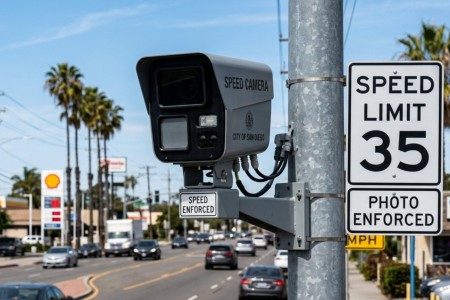
Legislation that would allow Long Beach to install speed safety cameras along Pacific Coast Highway has been sent to Governor Gavin Newsom.
Senate Bill 1279, authored by Senator Lena Gonzalez, representing Long Beach, received final approval from the California Legislature on August 25, 2026. The bill would expand the state's speed camera pilot program by including the portion of Pacific Coast Highway running through Long Beach, which is currently excluded under state law. The governor has until September 30, 2026, to sign or veto the legislation.
The legislation would allow Long Beach to install two speed safety systems along Pacific Coast Highway, in addition to those permitted under the city's existing pilot program. State Route 1, commonly known as the Pacific Coast Highway, is a state highway that currently prohibits the city from deploying speed cameras along the corridor. SB 1279 establishes a specific exception to this restriction.
Senator Gonzalez introduced the legislation to address a high rate of traffic fatalities along the corridor. Data from the office of Senator Gonzalez indicates that the eight-mile section of the highway through Long Beach accounted for 39 of the city's 192 traffic fatalities since 2020. State highways represent only 11 miles of the city's 217 arterial roadway miles, yet they account for 52 of the 192 crash fatalities since 2020. This represents 27 percent of the city's traffic deaths occurring on its roads.
Local traffic safety advocates supported the measure, citing recent fatal collisions. Damian Kevitt, the executive director of Streets Are For Everyone, stated that at least three speed-related traffic deaths occurred on Pacific Coast Highway in Long Beach during the first eight months of 2026. State data indicates that Long Beach is the eighth deadliest city in California for crashes on both surface streets and freeways, recording 54 traffic-related fatalities in 2025 alone.
SB 1279 is related to Assembly Bill 645, which established the state's speed safety system pilot program in 2023. Effective January 1, 2024, the law authorized six cities, such as Glendale, Los Angeles, and Oakland, to participate. The pilot is authorized to operate for five years or until January 1, 2032, whichever comes sooner.
The original program aimed to test the effectiveness of automated speed systems in reducing speeds. However, the legislation barred cameras on state highways, leaving Pacific Coast Highway without enforcement options. SB 1279 follows the precedent set by Senate Bill 1297, which in 2024 authorized Malibu to expand the pilot program to its portion of the Pacific Coast Highway.
Data from other pilot jurisdictions suggests that automated speed cameras reduce speeding. In San Francisco, transit officials reported a 72 percent reduction in speeding in the first six months after cameras were activated. In New York City's own implementation, speed safety systems resulted in a 75 percent decrease in speeding violations and a 14 percent reduction in traffic crashes.
Under state guidelines, the Long Beach systems would follow privacy rules. Cameras are limited to photographing rear license plates. They cannot capture images of the vehicle's front, nor can they photograph the driver or pedestrians. The use of facial recognition technology is prohibited, and all records must remain confidential. Public agencies can only access these records to administer the program and assess its impact.
During the first 60 days of the program, the automated systems will only issue warning notices. A driver's first violation for traveling 11 to 15 miles per hour over the speed limit must also be a warning notice. Subsequent violations carry financial penalties based on the recorded speed.
A driver traveling 11 to 15 miles per hour over the speed limit will receive a 50-dollar penalty. The penalty increases to $100 for speeds 16 to 25 miles per hour over the posted limit, and to $200 for driving 26 miles per hour or more over the posted limit. The maximum penalty is 500 dollars for speeds of 100 miles per hour or greater. These citations are civil penalties, which do not result in license suspension or points on the driver's record.
If Governor Newsom signs SB 1279, Long Beach will have the authority to plan and deploy the two speed cameras along Pacific Coast Highway. The pilot program is scheduled to remain in effect until January 1, 2032, at which point the authorizing law will be repealed unless extended.
For any inquiries or further information, please contact Jose Cervantes at JoseC.Press@pm.me
Category:
- Log in to post comments
Featured Video

Beachcomber
Copyright 2026 Beeler & Associates.
All rights reserved. Contents may not be reproduced or transmitted – by any means – without publisher's written permission.

