
Origin of Long Beach Lifeguards
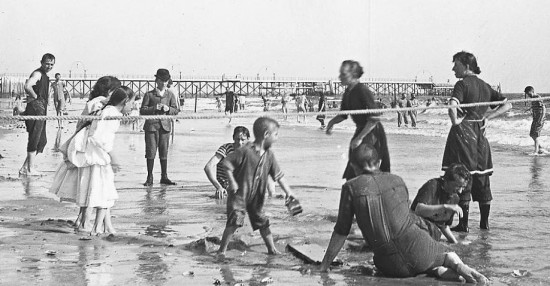
Following the tragic drownings of the Wallace girls in 1901, which I wrote about in my last Beachcomber article, Long Beach officials were quick to point out that these were the first deaths by drowning since 1896 when Grafton Abernathy, who was consumptive, drowned after spending too much time in the water.
All in all, Long Beach was a safe place to bathe, officials told the press. But they were wrong. They forgot to mention 21-year-old Albert Wise who had drowned June 3, 1899 and 6-year-old Irene Sears, who had been struck and stunned by a floating beam on July 10, 1901.
City officials changed their tune on June 27, 1902, when two strong men, J. Howard Long and E. Hayslip, died in separate drownings off the shore in Long Beach. Huge waves and a strong rip tide, that could be seen like a river flowing out through the sea greeted swimmers that day. The men should have known how to deal with the conditions, but they didn’t.
Hayslip’s body was recovered that day, Long’s four days later. Less than three weeks later two other men, Elmer Blum and Hjalmar Sundberg, lost their lives to the sea. All four drownings had taken place in front of Tent City, one mile west of downtown.
City officials said it would be impossible for them to patrol the nearly ten miles of beach which gave Long Beach its name, but they did post signs warning of the dangerous rip tides and placed a big raft anchored outside the breakers, in front of Tent City. However, many refused to heed the warnings and did not use the lifeline that had been placed at Asbury Park for their protection. Long Beach officials hoped the placing of the signs would shift the responsibility onto the bathers if they are reckless enough to swim there.
Further down the beach, in downtown, Charles Drake, owner of the fledgling amusement zone that would become known as the Pike, decided to take his own precautions.
On Feb. 5, 1902, Drake broke ground for his first venture into the tourist business − a bathhouse on the beach. The drownings and bad publicity had him worried. Long Beach officials had publicly stated the city could not be expected to patrol all of its several miles of beach front.
Drake realized that unless some measures were taken to reduce the public’s concern about the rip tides and drownings in Long Beach, his growing amusement zone could lose money. He quickly promised to put in lines and floats and establish a lifesaving patrol in front of his bathhouse. One man was hired to patrol the beach, while two manned a dory readied for rescue.
By the summer of 1904, the life guard service had paid off, at least according to the July 19, 1904 Los Angeles Herald, which reported that no one had drowned since 1902, after lifeguards had been hired to patrol the beach in front of Drake’s bathhouse.
G. Neese, G. Hewston and E. Herman manned their posts from 9 a.m. until 5 o’clock in the evening. “Clad in bright red bathing suits and caps, their skin burned a deep brown, these life savers are at their stations throughout the day in the scorching sun. Two are always to be seen in the lifeboat,” the Herald reported, “ready, just beyond the breakers and life ropes, resting on their oars and ready to speed through waves and breakers the moment occasion requires.”
The third lifeguard was stationed on the beach, watching the bathers, “ever ready to battle with tide and undertow and fight for another’s life.” So far in the season, which began on May 30, 1904, four bathers had been rescued from drowning by the “men in crimson suits.” The previous year they had rescued no less than 29 people.
Perhaps the most notable lifeguard in early years was George Falla (1882-1972), who performed “the most daring rescue ever made here of a person in peril in the surf,” according to the Daily Telegram (7/8/1908), saving the life of 16-year-old Walter Cooper, caught in a rip tide. Falla continued to work as a lifeguard on the Pike until 1912 when he joined the city’s municipal lifeguards taking on duties at the foot of Golden Avenue.
His rescues continued to make news. When asked about the job, he answered it was difficult contending with “fool bathers” who liked to shake the safety rope line leading into the water, plunging screaming women and children into the surf. He said if he caught the culprit, he would dunk the fool’s head in the water, holding him down until the prankster learned a lesson.
In 1910, Long Beach would institute a municipal lifeguard service, patrolling areas during summer months not funded by private bathhouses. By 1916, 14 guards were protecting bathers in the waters off Cherry, Golden, Alamitos and Orange Avenues, as well as the pier; but they were not happy with salary cuts imposed on them that year.
According to the Daily Telegram (7/19/1916), their $75 ($2,270 in 2025) a month salary they had been receiving since the service began six years earlier, had been reduced to $67.50 ($2,040) and they were now required to clean the beach each morning. At the same time, guards at the Pike bathhouse were still receiving $75 and did not have to clean the beach!
Claudine Burnett is a retired research librarian who has written more than 10 books on Long Beach history as well as numerous journal articles. For more, visit her website www. claudineburnettbooks.com.
Category:
- Log in to post comments
Featured Video

Beachcomber
Copyright 2026 Beeler & Associates.
All rights reserved. Contents may not be reproduced or transmitted – by any means – without publisher's written permission.

