
A Tent City Tragedy
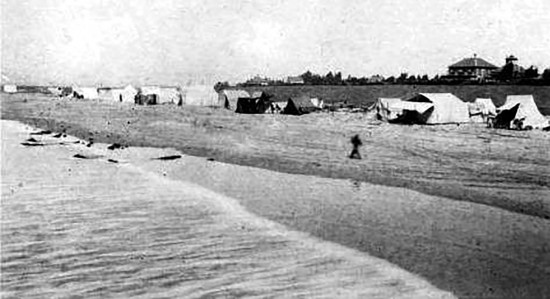
In my last article in the Beachcomber I wrote about the seemingly idyllic summer days spent in Long Beach in 1901. Many stayed in Long Beach’s tent city, including the Wallace family from Los Angeles. There was plenty to keep them busy. For food all they needed was a fishing rod to get fresh fish, and a shovel at low tide to bring up clams.
For entertainment there was the Pine Avenue Pier to stroll on, and the various lectures held at the Chautauqua, and Methodist conventions. During the day they basked in the sun and swam in the surf. By night they dodged mosquitoes and watched the star filled sky, wishing on the falling stars so prevalent during the annual August Leonid meteor showers.
But they were soon to discover that all their wishes could not bring back the lives of their two daughters and niece. They had learned the hard way that the ocean could be a murderous place, especially for those who could not swim.
For fifteen August days all of Southern California shared the anguish of Mr. & Mrs. Sam Wallace as they awaited news of their daughter Elsie. Fifteen-year-old Imogene, eighteen-year-old Elsie and twenty-year-old Cora Wallace were last seen alive August 10, 1901, bathing off the Pine Avenue Pier. They were with Fred Wilkinson and Harry Smith when an incoming wave swept all five off their feet.
Onlookers saw the girls and young men struggle with an undertow and pulled under before help could reach them. Smith was carried away from the others, but Wilkinson briefly held one of the girls by her hand while the other two also linked hands. But the pull of the waves broke their hold. None of the girls knew how to swim, though Elsie had been taking lessons. Smith and Wilkinson eventually made it to shore, but the three girls could not be seen.
A short time later Cora Wallace’s body was washed ashore, about 200 feet east from where they had disappeared in the sea. For two hours attempts were made to resuscitate her while beachgoers searched the surf for the other girls, but to no avail. Cora Wallace died. Her body was returned to the tent of her aunt and uncle, while searchers were still striving to recover the remains of the Wallace daughters.
Twelve days later, on August 22, 1901, fishermen found a body washed up on the sand. Though it was so badly decomposed and the face disfigured almost beyond recognition, the clothing identified the victim as Imogene Wallace. No formal identification was made by the parents “for fear the memory of seeing it (according to the Evening Tribune) would haunt them forever.”
The paper added: “Friends of the family describe the agony of the parents during these awful days as most heartrending. Day after day have they silently paced up and down the seashore, watching and hoping the waves would give up their treasures. In all the weary waiting no ray of comfort has come to them, and still they must wait, for the other daughter is still missing. God help the doubly bereaved parents.”
Elsie’s remains were discovered August 25, the day of Cora and Imogene’s funeral. Fishermen on the Pine Avenue Pier saw a dark body tossing on the water not far from where the old Magnolia Avenue Pier used to stand. A boat was sent to investigate, and it proved to be the long-sought-for body of Elsie Wallace. Wrapping it in canvas the crew brought it back to shore, where it was immediately taken to Wilson’s Undertaking Parlors. It was thought that Elsie’s body had become entangled in the seaweed around the old Magnolia Pier because her hair was thickly matted with kelp.
Cora and Imogene’s funeral was postponed until Elsie joined them the following day. On Sunday, August 26, 1901, three white caskets covered with white roses lay side by side. Three hearts of white carnations and roses were interlinked, as the girls were taken off for burial in Evergreen cemetery in Los Angeles.
Their deaths would give birth to the creation of Long Beach lifeguards.
Ocean tragedies still exist, as many of us who have followed stories this year of beach goers being swept out to sea by rogue waves. Lives were lost. It’s wise to remember the ocean may at times have a quiet, calming demeanor, but it can also be fierce.
Category:
- Log in to post comments
Featured Video

Beachcomber
Copyright 2026 Beeler & Associates.
All rights reserved. Contents may not be reproduced or transmitted – by any means – without publisher's written permission.

