
The Visible and Hidden History of Long Beach
The proposed closing of the Terminal Island Federal Prison by way of dangerous conditions in the heating tunnels inspired an examination of best-known local tunnels. For the most part, Long Beach is bereft of traditional tunnels. Of the four best-known and sometimes most notorious Long Beach tunnels, two are in active use. Two others are either sealed or not available for public use.
The Jergins Tunnel
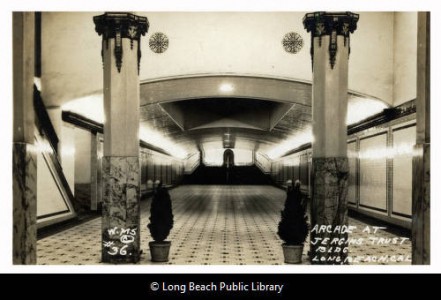
Likely the most famous of local tunnels, businessman Andrew Jergins built the Jergins Tunnel in 1927 to allow visitors easy access to the old Pike amusement park and to the Jergins Trust Building which housed the Markwell Theater, later the State Theater at 104 E. Ocean Blvd. Early in the 20th Century, a hotel located at the beach on the bluff, prompted a spur of the Southern Pacific Railroad. This caused the town to boom – as Alan Burks of Environ Architecture pointed out, “It was the beginning of Long Beach,” leading to the building of the once-iconic Jergins Trust Building in 1919 at the southeast corner of Pine Avenue and Ocean Boulevard, an essential development attraction, particularly its Jergins Tunnel.
Then-councilman Alexander Beck sponsored construction of the tunnel under Ocean Boulevard connecting the north side of the street to the building which housed the popular State Theater. Concessionaire stalls in the 181-foot-long tunnel arcade-like passageway displayed their wares as beachgoers passed on their way to the Pike, the theater or to the Superior Court, which was located in the Jergins building. At its peak, on the weekend, upward of 4,000 people crossed Ocean at Pine per hour.
When Ocean Boulevard was widened in the late 1960s, the north end of the tunnel was sealed as its north exit opened on the street, not the sidewalk as intended. Sealed since 1967, the Jergins Tunnels’ south entrance has been resealed at least four times after fires set by squatters or vandals. In a sense, the tunnel’s demise was advanced by the controversial demolition of the historic Jergins Trust Building in 1988, producing a decades-long giant hole in its place. Worth knowing: the tunnel has since become a burden for the city to keep encampment-free.
In 2023, the mayor announced that the tunnel would be used as a speakeasy at the planned Hard Rock Hotel, which has yet to break ground on the at Pine and Ocean vacant lot, though it’s promised to be completed for the 2028 Olympics. We’ll see.
Spring Street Tunnel
Construction of the Spring Street Tunnel, which connects Lakewood Boulevard to Redondo Avenue, as well as its twin, the Lakewood Boulevard Tunnel runway between Willow Street and Spring Street began in March 2, 1958 and finished in March 1959 at the cost of $3.5 million. It was needed as neighboring Daugherty Field, now the Long Beach Airport had to expand from 3,000 and 4,000-foot runways to 10,000-foot runways because of the new DC-10s rolling out of the neighboring Douglas plant. The opening of the tunnel was less than auspicious.
On March 2 1958, there was a four-to-five-hour traffic tie-up on Lakewood Boulevard for three miles from Conant to Willow (as well as downtown at a Douglas Aircraft union meeting and in the harbor). It was raining heavily that day, which also contributed to the traffic congestion. According to press reports, “several hundred persons spent more than an hour in the newly completed tunnel adjacent to Long Beach Airport.”
According to reports from the scene, “Four distraught motor officers unsuccessfully tried to cope with the jams until 3:30 p.m. when second shift came on duty to relieve them with approximately a dozen officers.” Worth knowing: the Spring Street Tunnel has a walkway beside the vehicle traffic part, but is not recommended for pedestrians or bicyclists.
Drive-In Jail
Located at 415 West Ocean Boulevard, the 11-story Long Beach Courthouse was an early example of the Corporate International Style or “curtain wall architecture” again, at the cost of $3.5 million. Not unlike the Jergins Building, which previously housed the Superior Court, it has its own tunnel, built for an entirely different purpose. Dubbed the “drive in jail,” it snaked from the 175.000 foot, six-story police public safety building at 400 West Broadway, planned and built at the same time as the neighboring court house; cost $3.7 million.
By the 1990s, the courthouse developed potentially dangerous shortcomings (stalled escalators and elevators), leading to its demolition in March 2016 in favor of a new courthouse blocks to the north. The revamped public safety building still stands, but the courthouse is gone. The new Deukmejian Courthouse on Magnolia has no such tunnel, meaning police have to drive prisoners for court appearances.
As to whether the tunnel still exists, and if so, its purpose, the police PIO referred the question to Public Works which responded, “the tunnel in reference is no longer accessible with the demo of the old courthouse and is not being used for any purposes.” Worth knowing: Don’t be caught using the underway passage between the police building jail and courthouse, which means you’ve been arrested.
Albury Tunnel
The Albury Tunnel was created under the 405 Freeway near the intersection of the 5900 block of Willow Street and San Vincente Avenue on the north and Vernon Street and 2200 block of Albury Avenue on the south to allow school-bound students enter at the on the north, go under the 405 Freeway and emerge at Stanford Middle and Prisk Elementary Schools.
According to resident Craig Breit, “I remember they finished the freeway in 1964, when I was about eight years old. They took an elephant onto the northbound freeway at Palo Verde Avenue. They wanted to show the strength of the construction at the ribbon-cutting.”
The first Albury Tunnel was created in 17th-Century England. Henry, the Sixth Duke of Norfolk laid out the design of the gardens of Albury Park, complete with “a long tunnel through the hill rising behind the quarter-of-a-mile long terrace.” The British Albury Tunnel is a bit of a tourist attraction.
Worth knowing: Long Beach’s Albury Tunnel is the way to connect children who live north of Willow Street to two schools on the south of the freeway, saving them from having to use the eastside’s most dangerous uncontrolled pedestrian crossing where the 405 empties at freeway speeds onto southbound Woodruff Avenue and toward CSULB.
Category:
- Log in to post comments
Featured Video

Beachcomber
Copyright 2026 Beeler & Associates.
All rights reserved. Contents may not be reproduced or transmitted – by any means – without publisher's written permission.

