
Witnessing a Sublime Comeback
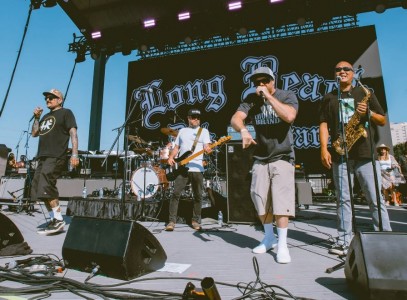
Long Beach has produced its share of musical talent, but few acts have left a deeper cultural footprint in a shorter time span than Sublime.
Formed out of several short-lived punk bands, Bradley Nowell, guitar and lead vocals, Eric Wilson, bass and Bud Gaugh, drums, created the ska-punk band Sublime in 1988.
Their first recording, on the band’s independent Skunk Records label, “Date Rape” became one of Sublime’s earliest hits. Released in 1991 on “Jah Jah Won’t Pay The Bills” cassette, was a KROQ chart hit in January 1995. Built around a surf-rock riff and accompanied by a cover of Bad Religion’s “We’re Only Gonna Die from Our Own Arrogance,” the single helped spread the band’s notoriety far beyond local clubs.
Next came “Badfish (40oz. to Freedom)” about a person trapped in addiction used party sounds with a modified reggae beat, including “water’s too polluted with germs” mixed in, hitting first in Hawaii in July 1994.
Zed Records’ Mike Zappelli recalled Sublime’s close connection to the store. “Sublime used to play at Cal State Long Beach. They’d tell people, ‘If you want our cassettes, go over to Zed Records.’ If we saw a young college girl who wasn’t punk parking in front of the store, we’d reach under the counter, get the Sublime cassette out for her. Sometimes they’d buy more than one.”
The demand quickly became noticeable. Young fans regularly came into the store looking specifically for Sublime recordings, often purchasing multiple copies. At the time, the band was still releasing music through Long Beach-based Skunk Records, operated by Michael “Miguel” Happoldt. “They had two demo cassettes,” which one seller listed on Discogs for $100,000, another for a bargain $4,999. The LP tops out at $1,499. The Record Store Day reissue is offered for $30.
Though Bradley Nowell died of a heroin overdose in May 1996 before the band’s commercial breakthrough, Sublime’s music continues to define an era and a city.
Immediately following Nowell’s death at age 28 on May 25, 1996, Sublime’s self-titled MCA debut broke the band wide open, charting at #50 nationally, introducing their blend of punk, rap, reggae and ska to a mainstream audience. Each of the following were part of that album.
Sublime’s “April 29, 1992 (Miami)”, released in July 1996, is a first-person account of the unrest that followed the Rodney King verdict. Long Beach journalist and music writer Sarah Bennett described the song as Long Beach’s “own news network.” Using actual Long Beach Police Department radio transmissions alongside descriptions of looting and civil unrest, the track presents a highly localized perspective on the riots.
In her unpublished essay, “Why Sublime Still Matters,” Bennett argued that the song transcended race and reflected widespread frustration with authority. “It didn’t matter if you were white, black, Mexican, Cambodian or whatever,” Bennett wrote. “The riots in Long Beach were about ‘the man’ bringing everyone down.”
Bennett also noted that the song gave listeners one of the few widely known accounts of the riots from a white participant’s perspective. “By ending with a list of cities the band had visited, Sublime transformed a local event into a national conversation, encouraging audiences across America to reflect on injustice in their own communities.”
The song received a limited-edition reissue on Record Store Day in 2009, becoming an instant collectible among fans and vinyl enthusiasts.
Released in summer of 1996, “What I Got” became Sublime’s biggest mainstream success and remains one of the defining songs of the decade, charting on KROQ in August. Bennett noted that the song’s verse melody closely resembles The Beatles’ “Lady Madonna,” while its chorus borrows heavily from Jamaican ragga artist Half Pint’s “Lovin’.” Yet Sublime transformed those influences into something distinctly their own. The song received extensive radio airplay throughout Southern California and eventually across North America, helping propel the band’s self-titled album to multi-platinum status.
“Santeria” remains one of Sublime’s most enduring songs. Released in December 1996, it blended reggae rhythms with Southern California storytelling, the track captures the laid-back beach culture that helped define the band’s identity.
Although released after Nowell’s death, the song became a radio staple and introduced a new generation of listeners to Sublime’s uniquely Long Beach perspective.
Released in June 1997, Sublime’s “Doin’ Time” adapted George Gershwin’s standard “Summertime” into a reggae-infused tale of troubled relationships, showing Sublime’s ability to absorb jazz, reggae, hip-hop, and classic American songwriting influences in creating something entirely original.
The song’s release required approval from the Gershwin estate, which insisted that the lyric include the phrase “summertime.” Because Nowell had originally recorded the song using only the phrase “doin’ time,” it was necessary to re-record those vocal portions after Nowell’s death.
While Sublime recordings sold briskly at Zed Records near the Traffic Circle, nearby VIP Records was helping launch artists such as Snoop Dogg, who contributed a rap to the 2006 redo of “Doin’ Time”. Symbolically, the stores reflected a uniquely diverse local music culture in the flourishing 1990s.
The other members attempted a comeback but were stymied as the Nowell family owned the Sublime name, thus they had to perform as the Long Beach Dub Allstars. In 2026, Brad Nowell’s 30-year-old son Jakob joined as lead singer, replacing his dad, creating a new version of Sublime, a relationship that existed since 2023. In doing so, the band members’ age disparity is up to 29 years.
Their current release is “Until the Sun Explodes” and single, “Ensenada” on Nowell’s SVN/BVRNT label. Attempts to reach the band through their website were unsuccessful.
As Nowell famously sang, “The Sublime style’s still straight from Long Beach.”
Category:
- Log in to post comments
Featured Video

Beachcomber
Copyright 2026 Beeler & Associates.
All rights reserved. Contents may not be reproduced or transmitted – by any means – without publisher's written permission.

