
AIBOT Sets Up Shop in Long Beach to Produce Air Taxis
Interested in taking an air taxi from Los Angeles to Las Vegas? Then stay tuned to watch what happens to AIBOT, a recent addition to Long Beach’s Space Beach community.
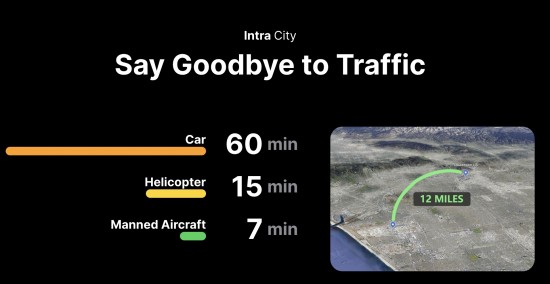
The company predicts that its technology will be able to take passengers from the LA area to Las Vegas within one hour. A one-hour car ride through traffic in the Long Beach and Orange County areas could be covered in 7 minutes in manned aircraft that the company is developing.
AIBOT will develop an engineering complex at the Long Beach Airport as part of its efforts to build the first generation of aerial taxis. That came from Mayor Rex Richardson during his “State of Business” presentation on Dec. 1 with Jeremy Harris, president and CEO of the Long Beach Chamber of Commerce, at the Westin Long Beach.
That engineering complex will be one of two that the company will build, with the other getting ready to go into the Mojave Space Port, Richardson said. Some of the funding is coming through a California grant for $15 million to begin building its logistic and design hubs.
The company recently moved into its new office at the Daugherty Sky Harbor Office Building at 2883 E. Spring Street in Long Beach.
AIBOT says that its “mission is to create an AI-defined, software-driven, ultra-high tech, hyper-performing, electric, internet-connected, and autonomous aiEVTOL aircraft and ecosystem.”
An electric vertical take-off and landing (EVTOL) aircraft is considered to be one that use electric power to hover, take off, and land vertically.
What It’s Building
Two major projects are being taken on by the company. One is to design an air taxi with seven seats and six-passenger capacity, a maximum takeoff weight (MTOW) of 7,000 lbs., and an all-electric propulsion system including eight rotors powered by eight separate electric motors. It would have a design range of 250 miles with a standard cruise speed of 200 mph. It will have a 47-foot wingspan.
A smaller aircraft is being designed as a drone, which the company says will be able to handle all kinds of missions. Some of those uses could include aerial inspection, traffic management, medevac services, organ transplants, and forest management, the company said.
AIBOT says that its drone will have a 17 ft. wingspan, 800-lb. MTOW, and 250-lb. payload. Like the air taxi, more details will be coming out on this flying vehicle later.
Honeywell inked a deal with the startup on November 14 to bring in Honeywell’s lightweight Compact Fly-By-Wire (cFBW) system. It enables the removal of conventional mechanical linkages controlling the effectors, streamlining maintenance procedures, and reducing costs throughout the entire lifecycle of an aircraft, according to Honeywell.
It also facilitates managing the drone version. It can send flight control commands to the flying taxi. The paperback-sized cFBW offers vehicle maker AIBOT greater flexibility in aircraft design without compromising power and safety. Its ability to tap into vertical takeoff and landing with its EVTOL technology makes using Honeywell’s eFBW more appealing for AIBOT.
Debut Event Coming Up
AIBOT is getting ready to host a company debut event soon at its Long Beach headquarters. That will set the stage for another event later next year: AIBOT plans to unveil its first commercial unmanned aiEVTOL aircraft, designed to serve a variety of industries including cargo, agriculture, high-speed inspection, and medical deliveries.
For those interested in being hired by AIBOT, the company will be expanding its team. Those seeking more information on the company and its career opportunities can find out more on the company website at aibot.ai. AIBOT invites potential staff members to come join a team “with the vision to disrupt the next generation of mobility, transforming the aviation industry to usher in the B2C era, making the freedom of flight an accessible reality anytime, anywhere in everyone’s daily life.”
The past decade has seen a near onslaught of announcements by major companies and investors to bring nearly sci-fi-like technology to market. In 2014, it was prompted by Google showing off its self-driving cars, and several major automakers announcing they would be doing the same within a year or two. Jeff Bezos, Elon Musk, and Richard Branson rolled out more details on their space travel ventures. Flying cars and taxis followed behind with several startups coming together and gaining financial backing.
For each of them, safety is the top concern expressed by government regulators and the public at large. These new operating systems offer a sense of wonder and awe to the public, but each of them has major safety issues to overcome. Autonomous vehicles have been sidelined after the 2018 fatal accident that killed a pedestrian in Arizona during an Uber test ride; fatal collisions using Tesla’s Autopilot semi-autonomous system have also dragged it out.
Flying taxis and delivery crafts will be watched carefully. Amazon continues to deploy small package-delivery drones. Once human passengers are included, that will raise concerns for safety regulators and air traffic controllers making sure that air traffic conditions are safe for all fights coming from airports of all types.
Jon LeSage is a resident of Long Beach and a veteran business media reporter and editor. You can reach him at jtlesage1@yahoo.com.
Category:
- Log in to post comments
Featured Video

Beachcomber
Copyright 2026 Beeler & Associates.
All rights reserved. Contents may not be reproduced or transmitted – by any means – without publisher's written permission.

