
Pier Wind Project Moving Forward
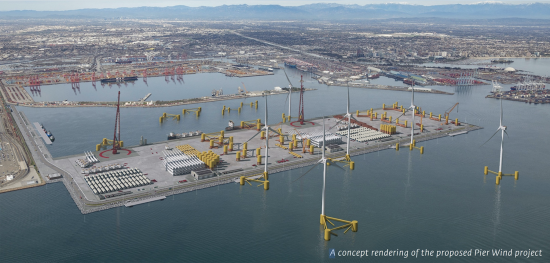
The Port of Long Beach is preparing for what it calls the Pier Wind project, a major terminal for offshore wind turbines that could provide many new jobs to the local community and help California hit its clean energy targets.
The proposed Floating Offshore Wind Staging and Integration facility – known as Pier Wind – would allow for the assembly of offshore wind turbines “standing as tall as the Eiffel Tower,” the port says. The turbines would later be towed to wind farms in Central and Northern California, and they’ll operate about 20 to 30 miles offshore.
The project would create jobs and economic opportunities for communities near the San Pedro Bay port complex – and help the state meets its clean energy goal that 25 gigawatts will be produced through offshore wind power by 2045. It’s one of two California projects getting state funding, with the other being based in Humboldt Harbor near Eureka.
Last year, the port stated that a recent preliminary economic impact report found that Pier Wind could create more than 6,000 jobs and generate $8 billion in labor income, $14.5 billion in economic output, and $1.3 billion in state and local taxes between now and 2045.
Long-time wind power critic President Donald Trump may not like this one. The Trump administration has been canceling offshore wind projects since its second term started nearly a year and a half ago.
The White House has taken actions against more than two dozen of these wind power projects. That has included making deals that will be converting over nearly $2 billion in funding to energy companies that held offshore wind leases in federal waters, to abandon those clean energy plans and switch over to investing in U.S. oil and gas projects, according to the Los Angeles Times.
The port says that the project would be located just south of the Navy Mole, east of Port of Los Angeles Pier 400, north of the federal breakwater, and west of the Main Channel. The land where it all takes place will come through a massive dredge-and-fill operation in the water. It will be a 400-acre terminal for the positioning, storage, and assembly of these very large offshore wind turbines.
The port says that construction could start as soon as 2027, with the first 200 acres completed in 2031, and the final 200 acres coming online in 2035.
What the CEO Says
Last month at the Pacific Offshore Wind Summit 2026 conference held at the Hyatt Regency in Long Beach, Dr. Noel Hacegaba, CEO, Port of Long Beach, spoke to these issues at a keynote address. He acknowledged that electric power demand is climbing in domestic manufacturing, digitization, and the rise of AI and data storage. The power grid that was built for the last century can’t carry us through the next, he said.
The rising cost of oil and all its implications is another reason that the port and the state of California have to take energy independence very seriously, he said.
“Rising fuel costs are sharpening the case for domestically produced power and for energy independence. A few weeks ago, the last oil tanker to depart the Middle East before the start of the Iran conflict arrived right here at the Port of Long Beach,” he said.
The Pier Wind project, and the Humboldt Harbor project, will be a significant part of the state reaching its decarbonization goals. The clean energy transition is not only an environmental story, it’s also an economic story, he said.
It will create opportunities in manufacturing, logistics, construction, engineering, maritime operations, and workforce development. It will be a critical part of meeting rising energy demand while also reducing dependence on imported fuels and volatile global markets, Hacegaba said.
“The Port of Long Beach has always been an engine driving working-class opportunity – and the zero-emissions transition gives us the chance to write that next chapter, with union labor, local hiring and real investment in workforce training.
At a time of global energy volatility, offshore wind is not just a climate strategy. It is a national security strategy. And the world is watching to see what California does next,” Hacegaba said in his keynote address.
Funding Sources
The proposed $4.7 billion Pier Wind facility is expected to be funded through a combination of state grants, local port funds, and expected federal or private investment. Initial costs are being funded by a $20 million grant from the California Energy Commission and $11 million in matching funds from the port.
Where the rest of that funding will be coming from is still an unanswered question.
The grant funding came from Proposition 4, the climate bond measure approved in 2024 by California voters which set aside $475 million for port infrastructure projects connected to offshore wind development. The Port of Long Beach will seek additional Proposition 4 proceeds for Pier Wind as the state releases those funds.
Gov. Gavin Newsom’s 2026-27 budget would defer the remaining $241 million that will be going to offshore wind power to a future year, and to whoever gets elected later this year to be the next governor.
Newsom signed a bill in 2024 that would streamline the design and development of Pier Wind by allowing the Port of Long Beach to use alternative construction delivery methods. That same year, the California Energy Commission adopted a final strategic plan for offshore wind energy developments for the state, authorized through Assembly Bill 525. The plan references the need to prioritize seaports, like the Port of Long Beach, to serve as assembly and staging sites for wind turbines, according to the port.
Jon LeSage is a resident of Long Beach and a veteran business media reporter and editor. You can reach him at jtlesage1@yahoo.com.
Category:
- Log in to post comments
Featured Video

Beachcomber
Copyright 2026 Beeler & Associates.
All rights reserved. Contents may not be reproduced or transmitted – by any means – without publisher's written permission.

