
Motorcycle Dealer Built a 2,000-Pipe Theater Organ
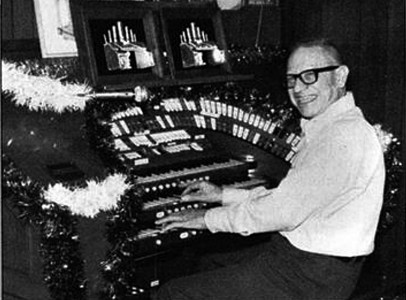
On Anaheim Street, a variety of businesses have thrived over the years. Many have come and gone, from the Cabart Theater in the 1950s, to the local headquarters of the John Birch Society in the late 60s to the head shop, the Generation Gap, a few years back. One business was rooted in the sales and service of motorcycles, Joe Koons Motorcycles, which gained worldwide fame through theatrical Hammond Organ concerts.
Motorcycles and movie-palace music may seem an unlikely combination, but for nearly two decades they coexisted under the same roof. Koons spent his days selling and repairing motorcycles at 1350 E. Anaheim Street. On Saturday nights, he entertained hundreds of people with one of the largest privately owned theater pipe organs in Southern California.
In 1956 he purchased his first full-sized Hammond organ, replacing a small spinet model. He added chimes, a rhythm box, unusual sound effects, red and green lights beneath the keyboards, and even a giant crash cymbal powered by a mechanism built from parts scavenged from an old Indian motorcycle.
Then he decided to add real organ pipes. Joe built a small pipe chamber next to the building and wired one rank of pipes to play from the Hammond keyboard. "It sounded horrible," he later admitted.
Instead of giving up, he did something few people would have considered. He decided to learn everything there was to know about theater pipe organs and build one from scratch.
Beginning in 1967 he started buying entire organs wherever he could find them and components from the Pacific Coast Club in Long Beach. Before long, garages beneath nearby apartments overflowed with wind chests, blowers, relays, consoles, pipes, percussion instruments and enough electrical wiring to intimidate most engineers.
Then disaster struck. A faulty washing machine in the apartment above flooded many of the carefully stored parts.
Fortunately, when Joe opened the organ chests he discovered they had survived remarkably well. The craftsmanship was so good, he later remarked they looked as though they had been built yesterday.
As his house wasn't large enough for the instrument, he installed it in his motorcycle shop. Word spread about it. Beginning in 1969, every Saturday evening motorcycles were pushed aside, folding chairs were placed throughout the showroom, and Joe opened the doors for free concerts.
Anyone who could play was welcome to sit at the console.
Professionals shared the keyboard with enthusiastic amateurs.
Visitors wandered through open pipe chambers while music thundered from ranks of Wurlitzer pipes, tubas, marimbas, glockenspiels, orchestral bells, traps and train whistles.
The showroom became one of Long Beach's most unusual entertainment venues. Groups including the Pasadena Shakespeare Club, the Organ and Piano Teachers Association, Millikan High School adult organ classes and numerous organ societies scheduled visits.
On Sept. 23, 1970, nearly 300 members of the American Theatre Organ Society crowded into the motorcycle shop for a concert. A few weeks later the American Guild of Organists held its own gathering there, featuring legendary theater organist Gaylord Carter.
Joe couldn't resist recording one of his favorite observations in his notebook. "Well received," he wrote. "I've made Christians out of 200 church organists."
Late in 1970 he purchased a magnificent three-manual Wurlitzer console originally installed in Buffalo, New York's Elmwood Theatre. By 1972 the organ had grown to 22 ranks, roughly 1,600 pipes. Joe estimated he had invested about $35,000 in the project.
Asked during a KRLA interview why he continued expanding the instrument, his answer was simple. "We'll let anybody play it that can play an organ. We've had some remarkable people play this organ. Some of the finest organists in the country have been here. They like this organ because it has everything they want. I wanted to be sure they had everything they needed."
Organists Del Castillo, Gene Roberson, Don Thompson, Ramona Gerhard Sutton and John Scot all recorded albums using the instrument. A third pipe chamber opened in 1973, bringing the organ to 32 ranks—about 2,000 pipes. Joe even designed and built a pneumatic mechanism to ring an authentic railroad bell. Customers often came looking for motorcycles and discovered an extraordinary pipe organ. Some returned just to hear the Saturday night concerts. Others simply wandered in because they heard music echoing down Anaheim Street.
Joe Koons died in 1978, but his wife, Spud, continued operating both the dealership and the Saturday night concerts. Declining motorcycle sales and expensive earthquake retrofit requirements made keeping the old Anaheim Street building impossible.
In May 1989, hundreds attended one final farewell concert featuring 96-year-old organist Del Castillo. After the applause died down, the giant Wurlitzer was dismantled, the pipes were removed and the chambers fell silent. Spud later relocated the motorcycle business to Rosamond, specializing in motorcycle restoration, hoping that the City of Lancaster might well have need for the organ in its planned music center. Unknown if that proposal was ever realized.
Category:
- Log in to post comments
Featured Video

Beachcomber
Copyright 2026 Beeler & Associates.
All rights reserved. Contents may not be reproduced or transmitted – by any means – without publisher's written permission.

