
Will New Port Office Building Inspire More Companies to Move into Downtown?
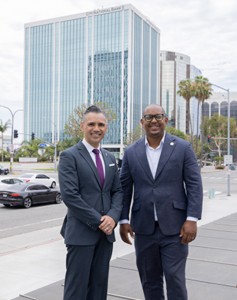
With the Port of Long Beach acquiring more office space downtown, the question comes up: what does the downtown commercial real estate market look like now?
The Downtown Long Beach Alliance reports that the office market is currently seeing a 66.20% occupancy rate. That’s down from the 67% occupancy rate experienced in 2025. The market is still reeling from last year’s significant drop from 2024’s 77.9% occupancy rate.
On August 6, the port agreed to purchase the $36 million building at 100 Oceangate, a 13-story building with 226,748 rentable square feet of office space and a five-story level parking structure. It’s right near its current headquarters office on 415 W. Ocean Blvd. Escrow is set to close by the end of August 2026, and the tower is currently about 70% occupied by existing tenants, the port said.
It came through Mayor Rex Richardson’s AnchorLB initiative. The Port of Long Beach is taking this step in acquiring a commercial office property to create a hub for companies connected to maritime trade. The building will also provide space for meetings, workforce development initiatives and “Port U,” the Port’s internal training and career development program.
There have been a few steps along the way by the port in supporting the mayor’s AnchorLB initiative, and the local business community’s desire to see a higher utilization rate for downtown office space.
The Port had operated its interim administrative headquarters near the Long Beach Airport area at 4801 Airport Plaza Drive, located right off Spring St. and near Clark Ave., from February 2014 to July 2019. That year, the Port returned to the waterfront, moving into an administration building at the new Long Beach Civic Center, adjacent to City Hall. The building, at 415 W. Ocean Blvd., is at the corner of Magnolia Avenue and Ocean Blvd.
The port is building the Port of the Future, guided by its 2050 vision and a plan to double annual container volumes to 20 million container units by 2050. By strategically modernizing the port’s infrastructure with $3.2 billion in capital investments over the next decade and developing digital systems to dramatically enhance efficiency and visibility, the port is advancing its goal to become the world’s first zero-emissions port.
The new office could be a hub for attracting more businesses to the downtown, and for improving the area’s occupancy rate and real estate market.
Occupancy rate challenge common in the Southland
Brandon Carillo, a principal at commercial real estate firm Lee & Associates, says that the South Bay office market has been going through a similar trend to Long Beach. Property owners have had to find solutions to seeing higher levels of empty offices than they’d hoped for, such as working out rent payments with tenants in sublease agreements, he says.
Companies have been frustrated with local government policies in Los Angeles County. Concessions have been given to renters in commercial and residential properties, but not to landowners; they’ve been expected to pay all their taxes even though a moratorium had been placed on evictions for residential and commercial residents who didn’t pay their rent. Some of these companies have moved their offices over to Orange County out of this frustration, he said.
The Southern California commercial real estate market does tend to correct itself, with the credit crises and ‘Great Recession’ starting in 2008 and the post-Covid environment being clear examples, he says. Lately, the tariffs and the military conflict in Iran and high fuel prices have had the most impact on the local economy, but the market is stable.
Lee & Associates’ Industrial Market Insight Q2 2026 confirmed these economic factors. The region does benefit from the types of companies that are utilizing industrial and commercial real estate space.
“Advanced manufacturing is emerging as a major source of industrial demand across Southern California, led by growth in aerospace, defense, space technology, clean energy, robotics, and other high-value production sectors. The region’s established supplier network, engineering talent, research institutions, and access to the ports continue to support facilities that combine research, prototyping, assembly, and production,” the report states.
Long Beach has the advantage of having its port, along with the Port of Los Angeles, that have done well in shipping volumes even during the tariff battles, Carillo says. Another positive sign has been the strength of “Space Beach,” Long Beach’s aerospace companies that are moving into, and expanding operations, in the Douglas Park area next to the Long Beach Airport.
The U.S. economic outlook for 2026 reflects a mixed picture shaped by lingering disruptions in the Middle East, an uneven labor market, and resilient but moderating consumer spending, according to the Lee & Associates report. Real GDP growth is projected to come in at 2.1% this year.
Overall, the commercial real estate market appears to be stabilizing in the South Bay (which includes Long Beach), though availability remains above the tighter levels recorded through much of 2024 and early 2025, according to Lee & Associates.
The Downtown Long Beach Alliance’s Data Dashboard reports that the downtown office market continues to feel the market pressures from post-pandemic uncertainties. However, with no new office construction and multiple adaptive reuse projects underway, and with renovations in large office buildings, this points to market adaption in response to changing office arrangements, according to the Data Dashboard.
Lee & Associates, DLBA, and other industry reports and metrics, point to long-term trends that have impacted the commercial real estate market. These include adapting to the post-Covid environment, seeing several companies move out of California, the impact of AI on energy consumption and cost, and several companies allowing employees to work more from home offices.
These reports do emphasize the need for governments and property owners to be very adaptive in this fast-changing environment. That could mean a commercial property owner is seeing a downturn in more expensive Class A offices, but they could be seeing increases in Class B and C offices.
That type of flexibility is providing a clearer picture for property owners, Carillo says. The aerospace industry’s presence in the Southland provides a good example of it.
“Aerospace is good for the South Bay, and it has a trickle-down effect,” he said.
That means supplier partners, and other businesses serving these companies, are seeing gains from aerospace companies in Long Beach, El Segundo, Hawthorne, Torrance, and other cities in the region. They’re bringing more jobs to this area, leasing more commercial space, buying more houses, and helping the local economy, he says.
Jon LeSage is a resident of Long Beach and a veteran business media reporter and editor. You can reach him at jtlesage1@yahoo.com.
Jon LeSage is a resident of Long Beach and a veteran business media reporter and editor. You can reach him at jtlesage1@yahoo.com.
Category:
- Log in to post comments
Featured Video

Beachcomber
Copyright 2026 Beeler & Associates.
All rights reserved. Contents may not be reproduced or transmitted – by any means – without publisher's written permission.

