
POLB Reaches Record Month in Its 115-Year History
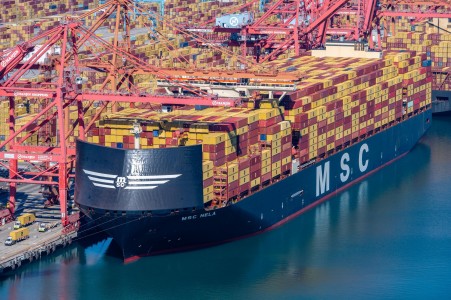
The Port of Long Beach processed 997,177 twenty-foot equivalent units (TEUs) of container cargo in September 2026, making it the busiest single month in the harbor's 115-year history. The record volume is up 25 percent from September 2025 and surpasses the previous monthly benchmark of 987,191 units set in October 2024.
The surge in overall container volume was driven almost entirely by inbound consumer goods arriving from Asian manufacturing centers. Loaded import containers entering the port jumped 31.3 percent year over year to 509,390 units. By contrast, outbound loaded containers carrying American products grew 7.8 percent to 91,747 units. The disparity created an import-to-export ratio of more than 5.5 to 1 for the month.
Outbound empty container movements worsened the imbalance, spiking 23.1 percent year over year to 380,299 units. Total empty container moves across the terminals reached 396,040 units. As a result, the port exported over four times as many empty shipping boxes as loaded containers filled with American goods.
"Shippers continue to lean on the Port of Long Beach as a reliable partner in their business strategies, leading to our historic month for cargo," said Noel Hacegaba, chief executive officer of the Port of Long Beach, during a monthly trade briefing. "Every milestone brings us closer to achieving our long-term goal of doubling cargo volumes to 20 million TEUs annually by 2050 as we build the Port of the Future."
Long Beach Harbor Commission President Steven Neal also applauded dockworkers and terminal operators for processing record volumes without marine congestion. In the first nine months of 2026, cumulative container throughput at Long Beach reached 7,675,255 units, a 3.9 percent increase from the same nine-month stretch in 2025.
Macroeconomic pressures and international routing adjustments fueled the surge in inbound cargo. Ocean carriers and beneficial cargo owners increasingly directed Asian import shipments to U.S. West Coast gateways to avoid ongoing transit limits at the Panama Canal caused by low water levels.
At the same time, importers accelerated purchasing schedules to hedge against potential policy changes tied to U.S. and China commercial trade negotiations following an extension of a bilateral trade truce.
High diesel prices also influenced ocean carrier routing decisions. With fuel costs remaining elevated globally, shipping lines prioritized direct Pacific crossings to Southern California over longer all-water routes to East Coast ports. Shorter ocean transits allow vessel operators to conserve fuel while maintaining schedule integrity.
While high import volumes generate great terminal revenue, transpacific container shipping dynamics work against domestic exporters. Ocean freight rates on eastbound import routes from Asia yield higher revenue per box than westbound export routes from North America.
Transpacific ocean carriers earn thousands of dollars moving high-value retail merchandise into the United States. Conversely, U.S. agricultural exports mainly consist of bulk commodities with narrow commercial margins that cannot absorb higher freight rates.
Because import freight rates command such a premium, ocean carriers prioritize container equipment velocity over export freight revenue. Returning an empty container directly to Asian export terminals lets carriers restock the box with another high-margin import shipment.
Rushing empty containers back across the Pacific requires minimal domestic dwell time and avoids positioning boxes into the U.S. interior.
In contrast, committing a container to an American agricultural shipper involves routing the box to inland elevators, waiting for agricultural loading, returning the loaded box to the coastal port, and completing export customs clearance.
This inland turnaround cycle can tie up equipment for three to four weeks. During periods of tight vessel capacity, ocean lines calculate that the financial gain of positioning empties in Asia far exceeds the marginal revenue from transporting American farm goods.
This equipment positioning strategy creates severe operational hurdles for domestic agricultural exporters. At the port's trade briefing, Peter Friedmann, Executive Director of the Agriculture Transportation Coalition, explained the challenges American farm producers face.
"There's nothing we produce in agriculture or forest products in our country that cannot be sourced somewhere else in the world," Friedmann said during the briefing. "If we do not deliver affordably dependably to our foreign customers, those foreign customers can and will find alternatives to the U.S. sourcing."
Friedmann noted that international buyers in Asia have increasingly turned to competing export nations, including Brazil and Peru, for key agricultural commodities like soybeans, grain, and meat. When ocean carriers reduce export bookings or restrict container availability at inland rail terminals, domestic producers lose sales and market share.
Unlike manufactured retail goods, agricultural commodities are perishable and time-sensitive. Delays in ocean transport can cause spoilage, degrade shipment quality, and damage long-term commercial relationships.
High diesel costs compound these logistical burdens for rural exporters. In California, retail diesel prices exceeded $8 per gallon, raising trucking expenses across the supply chain. Because agricultural exports are dense and heavy, inland trucking rates carry substantial fuel surcharges. When high trucking costs combine with ocean carrier fees and narrow return windows, total transport costs can exceed the product's profit margin.
Federal truck weight regulations further constrain inland transportation. The United States enforces an 80,000-pound gross vehicle weight limit on federal highways. "Every country except Japan has higher allowable truck weight limits," Friedmann pointed out during his discussion.
Because of this weight cap, agricultural shippers in California often must use two trucks to move the same volume of heavy freight that competing agricultural nations can move in a single vehicle, doubling fuel and driver expenses.
The immediate challenges facing agricultural exporters contrast with the port's broad long-term expansion goals. Long Beach officials are pursuing a $3.3 billion capital improvement program designed to double annual cargo capacity to 20 million container units by 2050. Central to this long-range effort is developing the Pier B On-Dock Rail Support Facility.
The Pier B project aims to shift more container movements directly onto rail networks, connecting marine terminals with major intermodal hubs operated by Union Pacific Railroad and BNSF Railway. Port leadership emphasizes that expanding on-dock rail infrastructure will improve container velocity for imports while creating better intermodal connections for outbound agricultural shipments arriving from the Midwest and Central Valley.
In response to immediate regional traffic pressures, including the 16-month closure of the nearby Vincent Thomas Bridge for deck replacement starting in November, Long Beach has implemented temporary extended terminal gate hours.
The gate incentive program provides harbor drayage trucks with evening and Saturday access through early December. Port officials hope the extended hours will maintain terminal fluidity and help truckers move containers efficiently despite detours around the harbor complex.
For any inquiries or further information, please contact Jose Cervantes at JoseC.Press@pm.me
Category:
- Log in to post comments
Featured Video

Beachcomber
Copyright 2026 Beeler & Associates.
All rights reserved. Contents may not be reproduced or transmitted – by any means – without publisher's written permission.

